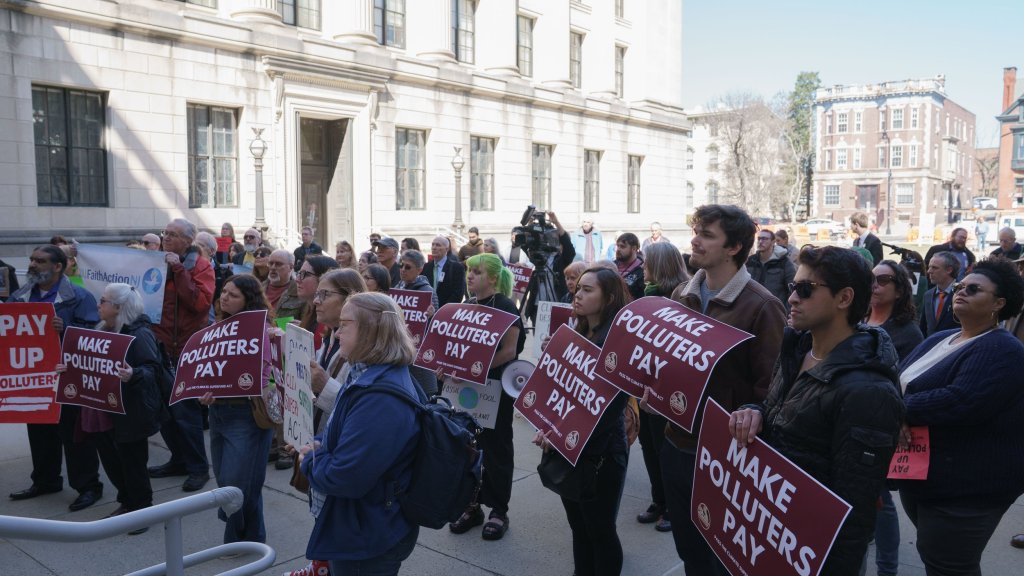
Climate Revolution Action Network activists protest outside the New Jersey State House. – Photo via Climate Revolution Action Network
For Gen Z, caring about the environment is more than a trend– it’s a revolution. Young activists at the Climate Revolution Action Network (CRAN) are using internet algorithms, testimonials to lawmakers, and news aggregation to inspire people their age to make an impact that lasts.
“Our goal is two words, uplift and coordinate youth voices to fight the climate crisis,” Executive Director and Founder Ben Dziobek said.
The volunteer organization does this by making short-form content on social platforms like Instagram, where they currently have over 5.9k followers, and TikTok, where they have a total of 34.8k followers, with 1.9M likes across all videos. They also attend local and state government meetings where they protest, testify, and organize in front of some of the state’s most powerful legislators. They also offer internships and fellowships for students who want to get involved.
They don’t make any profit, or receive any funding for the work they do– everything is volunteer, motivated by a mutual passion for climate change advocacy, according to Dziobek.
“All of this is 20 year olds pulling together $20 that they have to pay for a website and all of this stuff,” Dziobek said. “All of this stuff is volunteer. There’s not a single paid staffer on our team.”
For Kayleigh Henry, CRAN’s Pine Barrens Lead, the organization was pivotal for getting field experience, and spreading the word about what she was already studying at Stockton University. In a digital atmosphere where many people her age are concerned with superficial content like product reviews or hair tutorials, she wanted to use social media to advocate for her passion, helping the environment.
“Maybe we should start focusing on this, rather than focusing on other things that don’t really matter as much, like doing our nails or doing our hair,” Henry explained. “Like, let’s focus on the climate. Let’s be hot girls for climate.”
The videos still use Gen Z lingo and trends to capture their audience, and show young people that climate advocacy is for everyone– especially young people who aren’t always given a seat at the table because of their age.
Social media is only one part of the equation though, CRAN volunteers also show up when climate policies are being voted on by legislators. This March, many of them headed to the NJ State House, to testify in support of the “Climate Superfund Act,” which will make corporate polluters pay for damages done to the planet.
“Climate change is more than the environment. It’s more than just about us as humans. It’s more about the type of policies that are involved, the type of actions that are being taken place, how protests are needed, so that more people are hearing about these issues,” Henry said.
Sofia Calderon, is an incoming freshman at the University of Vermont. She showed up to committee meetings with CRAN when she was still in high school, as a part of her school’s internship program. Her experience showed her that there’s more to activism than individual impact.
“People get really focused on, like, like individual actions and stuff like that. But I think what CRAN does really well is help people understand that there’s, like, bigger fights to fight and things that will have a larger action, that will actually help a lot of people,” Calderon said.
One of the pillars of the organization is community. Finding other activists, and encouraging one another is a crucial key to its success.
“I cannot do this alone. Any of our directors cannot do this alone, and it’s only when we build people up in this space and then forcibly shove them into the legislature, into protests, into speaking, into local actions on the ground where they become regular, recognizable figures that are not just some kids that are in the room, but are some young people pushing the bar,” said Dziobek.
 The Lotus Review
Leave a comment